


Hidden Modrenism in Barcelona, Key Takeaways:
- Hidden Modernisme Barcelona — There is a very authentic but less obvious Barcelona Modernism appearing in doorways, courtyards, tiles, and street furniture.
- Craft as identity — Ironwork, sgraffito, and stained glass turned private buildings into status symbols and cultural statements.
- A non-Gaudí route — Follow Jujol, Domènech i Montaner, Falqués, Sagnier, and Puig i Cadafalch for hidden architecture beyond the famous façades.
- Read the pavement — Gaudí-designed street paving patterns reveal how Modernism reached Barcelona’s sidewalks and public squares, not only buildings.
Have specific questions? Jump directly to the FAQ section below for clear, practical answers. looking for the perfect Barcelona experience that combines architecture, lifestyle and authenticity? Book a private Barcelona tour by sidecar motorcycle with BrightSide Tours. The Half Day Barcelona City Tour is the perfect choice. A great mix of cultural highlights, historical background, local secrets and amazing viewpoints in just 3.30h.

The Story Behind Modernism in Barcelona: How a Movement Entered Daily Life
Modernisme took hold during a period of rapid urban change, as Barcelona expanded and the bourgeoisie commissioned ambitious buildings that turned the city into a laboratory of design and identity. Barcelona expanded, the bourgeoisie commissioned ambitious buildings, and the city became a laboratory for design, pride, and experimentation. Known internationally as Art Nouveau, Catalan Modernism developed its own distinct language. What matters for your walk today is how Modernisme spread beyond major commissions and into the ordinary fabric of the city. You see it in residential stairwells, in shopfront ironwork, in ceramic surfaces designed for durability and beauty, and in civic elements that framed everyday movement.
Dress to Impress
There is an important realization when exploring hidden modernism in Barcelona: the layers feels so authentic precisely because it was built for use, not for spectacle. A modernist entrance needed to impress, but it also had to function. A gate protected the home. A lantern illuminated the street. Tiles were designed to withstand constant foot traffic and Mediterranean humidity. In this sense, Modernisme’s most compelling expressions are often the ones you were never meant to buy a ticket for.
As you explore, you’ll notice how Catalan Modernism sits between imagination and practicality. Ornamental iron becomes structural. Floral motifs become wayfinding. A façade tells you who funded it, what they admired, and what they wanted Barcelona to become. This is where “Barcelona Modernism” stops being a style and becomes a social document.
The Quiet Heroes: A Non-Gaudí Route Through Barcelona Modernism
A strong hidden-architecture route is ultimately a story of authorship. Gaudí is omnipresent in Barcelona’s imagination, but Modernisme was a chorus, not a solo. For a richer narrative, we should not forget the quieter heroes who shaped street-level Modernism and who often contrast with Gaudí’s vision, offering a more holistic picture of the period in which these buildings were imagined, designed, and built. Here are the most significant heroes of hidden modernism in Barcelona.
Josep Maria Jujol is a key figure for “hidden architecture” because his genius often lives in surfaces and details rather than grand composition. His work is playful, symbolic, and occasionally eccentric, and you can feel how Modernisme evolves toward something more personal and experimental in the 1910s and 1920s.
Then there’s Pere Falqués, whose contribution is civic. Modernisme becomes truly “Barcelona Modernism” when it exits private patronage and enters public space. Falqués helped define how the city is experienced through urban design and street furniture, making Modernisme something you encounter while moving, not only while visiting.
Enric Sagnier is another essential name for premium travelers because his work often rewards a trained eye. He brings elegance and proportion, using ornament intelligently instead of loudly. That restraint is precisely what makes certain façades feel sophisticated rather than theatrical.
Finally, Puig i Cadafalch gives you Modernisme with a historical imagination, often referencing Gothic or medieval forms, but executed with modern craft. Following these architects changes your experience: the city becomes legible as a creative network, not a single-genius museum.
Modernism by Night
Arguably the most magical experience of Catalan Modernisn in Barcelona is by night, when many of these spectacular buildings are beautifully lit up and the city shows its most playful and fun loving atmosphere. For that reason, at BrightSide Tours we offer a spectacular Sunset & Night Tour of Barcelona By Sidecar Motorcycle with a private local guide. An unforgettable ride across town by the most spectacular buildings (with stops for explanations and photos), the best sunset views from the top of Montjuic Hill and the fun atmosphere all across town.

12 Hidden Modernist Works You Can See in Barcelona Today
Below are 12 concrete stops for a hidden modernism in Barcelona walk that help you sharpen your lens and begin recognizing ironwork like vines, tiled thresholds, and stained glass woven into daily life. As you move through the city, you start noticing repeating patterns and cultural signals everywhere: ironwork like vines, tiled thresholds, stained glass in stairwells, and civic design woven into the street itself. Most stops are best appreciated from the exterior, with quick, context-rich pauses and no interior logistics.

Palau Güell (Antoni Gaudí)
A compact urban palace just off La Rambla, built for Eusebi Güell. Find it on Carrer Nou de la Rambla and look for the twin parabolic entrances and ornate iron gates. The rooftop chimneys are a quiet preview of Gaudí’s later imagination.
Passeig de Gràcia Gaudí street paving
This is Modernisme under your feet: hexagonal pavement tiles associated with Gaudí’s design language. Walk Passeig de Gràcia slowly and scan the sidewalk patterning, especially near major shopfronts. It’s a subtle reminder that Barcelona Modernism also shaped civic space.

Casa Comalat (Salvador Valeri)
A two-faced building with a “polite” front and a more playful rear. Go to Avinguda Diagonal for the formal façade, then walk around to Carrer Còrsega to see undulating balconies and tilework that feels like a private joke in public space.
Casa Planells (Josep Maria Jujol)
A late Modernisme apartment house that whispers rather than shouts. Find it on Avinguda Diagonal and look for soft curves, compact geometry, and subtle iron details. It’s a smart stop to see how Art Nouveau in Barcelona evolved toward lighter, more experimental forms.
Casa Macaya (Puig i Cadafalch)
A refined white-stone townhouse with sgraffito, sculpted detail, and elegant ironwork. You’ll find it on Passeig de Sant Joan; it’s easy to reach on foot from Arc de Triomf or Tetuan. Pause for the entrance and balconies, where the craftsmanship is especially legible.
Casa de les Punxes (Puig i Cadafalch)
A castle-like city residence with spiked towers that look medieval at first glance. Locate it near Avinguda Diagonal and Carrer Rosselló; the best view is from the wider corner pavements. Look for symbolic ceramic panels and Gothic-inspired stonework.

Palau del Baró de Quadras (Puig i Cadafalch)
A sculpted façade that reads like a storybook of medieval references, executed with modern confidence. Find it on Avinguda Diagonal. Stand back to absorb the full composition, then move closer for carvings, balconies, and the dense ornament around windows.
Fàbrica Casaramona (Puig i Cadafalch), now CaixaForum
Industrial Modernisme done with discipline and beauty. It sits by Montjuïc near Plaça d’Espanya; look for refined brickwork, towers, and iron gates. Even without entering, you can read how Barcelona Modernism served industry, not only private homes.
Castell dels Tres Dragons (Domènech i Montaner)
An Expo-era building in Parc de la Ciutadella that feels like a brick fortress with Modernisme DNA. Walk in from Arc de Triomf and you’ll spot it along the park’s central routes. Look for exposed brick, iron, and that early modernist civic ambition.

Plaça Reial lampposts (Gaudí)
One of the most elegant examples of Modernisme you encounter at night without realizing it. Go to Plaça Reial just off La Rambla and look for Gaudí’s early forged-iron lamps. They blend function with Art Nouveau silhouette in one of Barcelona’s most social squares.
Casa Antònia Burés (Enric Sagnier)
A beautiful Eixample residence that rewards slow looking. Find it on Carrer Ausiàs March. Step back for proportion, then move in for carved stone, iron balconies, and ornament that feels composed rather than excessive, especially in late-afternoon angled light.
Casa Amigó (Enric Sagnier)
A quieter, more refined Modernisme stop for travelers who prefer restraint. It’s best found as part of an Eixample walk between Diagonal and the central grid streets. Look for elegant window framing, subtle floral motifs, and ironwork that never feels performative.
Modernisme by Neighborhood: How Your 12 Stops Map the City’s Growth
Modernisme didn’t spread through Barcelona evenly; it followed expansion, capital, and civic ambition. It followed the city’s expansion, and it followed money. If you place your route on a map, your 12 stops naturally fall into three Barcelona stories: the bourgeois Eixample, the renewed old town, and the former surrounding towns that later became today’s neighborhoods. Once you see that pattern, you stop “collecting buildings” and start reading how the city itself evolved.
1) Eixample: Where Bourgeois Barcelona Built Its Modernisme Identity
During industrialization, the Eixample became the preferred canvas for the new bourgeoisie. Wide streets, fresh plots, and façades that could project status, taste, and Catalan confidence. That’s why so many of your clearest Modernisme moments sit here, especially along the grid between Passeig de Sant Joan and Avinguda Diagonal.
Casa Macaya shows the movement at its most refined, with white stone, sgraffito, and ironwork that feels intentionally composed. Nearby, Casa Antònia Burés rewards slow looking, with ornament designed to be read in angled light rather than shouted from a distance. On Diagonal, you can feel Modernisme’s range. Casa Comalat flips from a polite frontage to a more playful rear façade, while Casa Planells offers a late, lighter language that hints at where Art Nouveau was heading.
Add the medieval-fantasy skyline of Casa de les Punxes and the sculpted storytelling of the Palau del Baró de Quadras, and the Eixample becomes legible as Barcelona’s modernist “showroom,” built for public admiration from the sidewalk.
2) Old Town Renewals: Modernisme as a Precise Intervention
Ciutat Vella was not the main bourgeois expansion district, but it was constantly renewed, and Modernisme appears here as a series of sharp, deliberate interventions. It is less uniform than the Eixample, but often more surprising. Palau Güell, just off La Rambla, shows how modernist ambition could be tucked into the tight fabric of the old city, where an iron gate and a dramatic entrance sequence do as much work as a broad façade. Nearby, Casa Bruno Cuadros turns a commercial frontage into street theatre, a reminder that Modernisme also lived in retail culture, signage, and the everyday performance of the street.
Then, in Plaça Reial, Gaudí’s lampposts prove the point beautifully: Modernisme didn’t only belong to private patrons. It entered public life through objects designed for nightly use, quietly shaping atmosphere long after the crowds move on.
3) The Former “Outside” Barcelona: Gràcia, Sant Gervasi, Horta, Sarrià, and Beyond
The third layer is the one most travelers miss because it requires a mental shift: these places were once separate towns or semi-rural edges, and later became Barcelona neighborhoods. Back then, the true bourgeois stage was the Eixample and its immediate extensions, while the old center remained denser and more mixed. B
ut as Barcelona expanded and absorbed places like Gràcia, Sant Gervasi, Sarrià, Horta, Sant Andreu, and Sants, Modernisme travelled with it. You see it in residential streets where façades become quieter, more local, and less performative, but the craft remains: ironwork, tiles, and stained glass designed for everyday living.
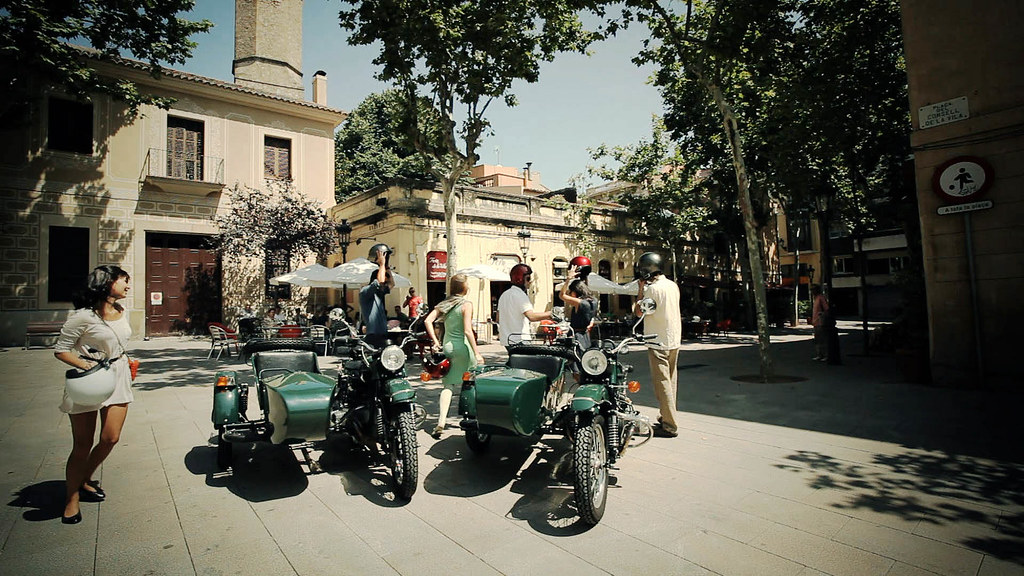
This is where your eye-training pays off most, because the signals are subtler and more local. In these areas, the goal isn’t to find a famous name on a plaque. It’s to recognize the patterns: a floral iron balcony that echoes the plane trees, a portal that still holds its original ceramic floor, a stairwell window that turns afternoon light into color. Once you’ve walked your Eixample and old-town stops, these neighborhoods become the next chapter, where Modernisme feels less like heritage and more like a living accent still spoken by the city.
At this point you are ready to customize your own modernism route and for that we highly recommend a complementary read of our Guide To The Modernisme Houses in Barcelona. And if you are travelling around Catalonia, then definitively you should read more about Modernist Architecture in Barcelona.
Of course, the #1 insider tip we can give you, is to book a private Barcelona Tour by sidecar motorcycle with a BrightSide Tours. Your private guide will pick you up at your hotel, tailor the route according to your personal preference and take you on a travel experience you will forever cherish. The best seller and top recommendation is the Half Day City Tour by Sidecar Motorcycle as it offers the perfect overall introduction to Barcelona. If however you are a true foodie and curious about the city at night, we invite you to experience the unique Tapas & Sunset Barcelona Foodie Tour by Sidecar Motorcycle.

Conclusion: Architectur as a Way of Knowing the City
Hidden Modernism in Barcelona rewards you for doing one simple thing: slowing your eyes down. Once you start reading the city at street level, Barcelona Modernism becomes less about famous façades and more about a lived cultural language. You see it in portal thresholds worn smooth by generations, in wrought-iron filigree that behaves like drawing, in stained-glass landings that turn ordinary stairwells into light chambers, and in civic details that make design feel public rather than precious.
The deeper pleasure is how quickly this changes your sense of place. The Eixample becomes a bourgeois “showroom” of ambition and taste. Ciutat Vella becomes a sequence of precise interventions, where Modernisme threads itself through older streets without overpowering them. And when you drift toward the former “outside” Barcelona, the style quiets down, but the craftsmanship persists, like a local accent that never disappeared.
If you want to experience hidden modernism in Barcelona with maximum ease and context, a private, city-center route lets you cover more ground while keeping the focus on observation, pacing, and atmosphere. Our #1 pick is no doubt the memorabe Barcelona Tour by Sidecar.
FAQ’s: Hidden Modernism in Barcelona
What’s the best time of day to notice hidden Modernisme details clearly?
Late afternoon, roughly 16:30–18:30. Side light reveals relief carving, iron filigree shadows, and tile texture without harsh contrast.
Which Barcelona neighborhood gives the highest Modernisme density in the shortest walk?
Eixample Dreta, between Passeig de Sant Joan and Avinguda Diagonal. You’ll cover multiple façades within two or three blocks.
How do you quickly identify a Modernisme building without knowing the address?
Look for wrought-iron balconies with botanical curves, carved stone window frames, and patterned ceramic or mosaic at street level.
Where should you look first when stopping in front of a building?
Start at the portal. Original tile floors, iron gates, and stained-glass stairwells often survive there even when façades are restrained.
How can you observe interior details without entering private space?
Stand just outside the threshold and look upward. Stairwell glass and iron railings are usually visible from the street.
Where exactly can you find Gaudí’s street paving without hunting for it?
On Passeig de Gràcia, especially near major crossings. Watch the sidewalk for repeating hexagonal tiles beneath your feet.
How long should a well-paced hidden Modernisme walk realistically take?
Two to three hours for 8–12 stops. That allows observation, short photo pauses, and neighborhood transitions without visual fatigue.


